%20(Logo).png)

%20(Logo).png)
What Grounds Our Work
The learning theory behind our REaL Learning approach
Experiential Learning Theory
Experiential Learning Theory (ELT), most closely associated with David Kolb, provides a strong foundation for understanding how learners develop deeper knowledge through experience. Kolb’s Experiential Learning Cycle explains learning as an ongoing process in which individuals engage in a concrete experience, reflect on what occurred, develop new understanding, and apply that understanding through future action. Learning is therefore not limited to receiving information; it is constructed through the interaction of the learner, the subject matter, and the physical and social environment. This process brings together doing, observing, thinking, and trying, allowing learners to connect cognitive, affective, and social dimensions of learning. Reflection is especially important because it transforms an activity into learning by helping individuals interpret their experience, identify patterns, connect new insights to prior knowledge, and make informed decisions about what to do next.

ELT is particularly well suited for Career-Connected Learning. By engaging in authentic challenges, using professional tools and practices, collaborating with others, and receiving feedback from educators, mentors, and industry professionals, students develop academic knowledge, durable skills, workplace understanding, and career identity at the same time. The experiential cycle deepens these experiences by ensuring that students do more than participate: they reflect, make meaning, test new ideas, and transfer their learning to future academic, career, and community settings. In this way, ELT provides both the theoretical grounding and practical structure needed to design Career-Connected Learning that is relevant, rigorous, reflective, and connected to students’ possible future selves.
Career Construction Theory
Career Construction Theory, most closely associated with Mark Savickas, provides a strong foundation for understanding how individuals develop career meaning through their experiences, evolving self-concept, and interpretation of possible future selves. Rather than viewing career development as a single decision or fixed pathway, the theory emphasizes an ongoing process of making meaning from experiences and adapting over time. Four career adaptability capacities are particularly relevant in K–12 education: concern, or the ability to imagine and prepare for the future; control, or a sense of agency in shaping one’s direction; curiosity, or the willingness to explore possible selves and environments; and confidence, or the belief that one can take action and overcome barriers. Together, these capacities help learners reflect on who they are becoming and how their experiences influence the futures they can imagine for themselves.
.png)
Career Construction Theory is particularly well suited for Career-Connected Learning because it helps students move beyond simply learning about occupations to making personal meaning from career-related experiences. Through exposure to professionals, authentic challenges, real-world applications, and opportunities for reflection, students can begin to connect their interests, strengths, values, and experiences to future possibilities. Career-Connected Learning creates repeated opportunities for students to explore, reflect, and revise their understanding of themselves in relation to the world of work. In this way, Career Construction Theory supports BVEF/REaL Learning’s focus on helping students develop career awareness, agency, adaptability, and a stronger sense of connection between who they are today and who they may become in the future.
Social Cognitive Career Theory
Social Cognitive Career Theory (SCCT) provides a strong foundation for understanding how career interests, choices, and goals are shaped by the interaction of personal beliefs, learning experiences, and environmental conditions. Rooted in social cognitive theory, SCCT emphasizes the role of self-efficacy, or an individual’s belief in their ability to succeed; outcome expectations, or what they believe may result from pursuing a particular path; goals, or the choices they make about what to work toward; and the learning experiences that shape these beliefs over time. The theory also recognizes the importance of supports and barriers within a learner’s environment, acknowledging that access, encouragement, opportunity, and context can influence what individuals believe is possible for them.
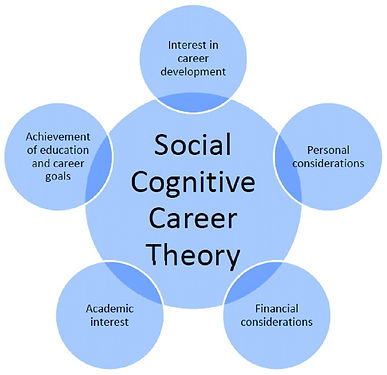
SCCT is particularly relevant to Career-Connected Learning because students’ aspirations are shaped not only by their interests, but also by the experiences they have access to and the confidence they develop through those experiences. Meaningful exposure to careers, interactions with industry professionals, authentic learning experiences, mentorship, feedback, and opportunities to practice real-world skills can strengthen students’ self-efficacy and expand their understanding of possible pathways. At the same time, attention to supports and barriers helps educators and partners recognize where students may need additional access, encouragement, or experience. In this way, SCCT supports BVEF/REaL Learning’s work to broaden students’ exposure to possibilities, strengthen agency and confidence, and create learning experiences that help more students see a meaningful future for themselves.
Additional Research That Informs Our Work
In addition to Experiential Learning Theory, Career Construction Theory, Social Capital Theory, and Social Cognitive Career Theory, BVEF/REaL Learning’s work is also informed by research on identity, access, relationships, learning design, durable skills, and educator practice.
Possible Selves and Career Identity
Possible Selves Theory explains how students’ images of who they may become influence motivation, goal setting, and behavior (Markus & Nurius, 1986). This research reinforces the importance of helping students understand their strengths, identities, interests, and values while connecting present learning to meaningful and attainable future possibilities.
Culturally Responsive Teaching
Zaretta Hammond’s culturally responsive teaching framework (2015) emphasizes that culture, identity, trust, and relationships influence how students process information and engage in rigorous learning. This research supports learning experiences that draw on students’ existing knowledge, build intellectual independence, maintain high expectations, and help learners see themselves represented in professional and future-facing roles.
Universal Design for Learning
CAST’s Universal Design for Learning framework supports proactively removing barriers through multiple means of engagement, representation, action, and expression. This research helps inform the design of authentic challenges, professional interactions, mentorship opportunities, and demonstrations of learning that are accessible, meaningful, and appropriately challenging for diverse learners.
Durable Skills Research
America Succeeds’ research supports BVEF/REaL Learning’s focus on communication, collaboration, critical thinking, creativity, leadership, and related durable skills. Its analysis of more than 82 million job postings found broad employer demand for these competencies across industries and occupations (America Succeeds, 2021). Updated research indicates that demand for durable skills remains strong, including within highly technical fields (America Succeeds, 2025). This reinforces the importance of giving students repeated opportunities to practice, receive feedback on, reflect upon, and demonstrate these skills through authentic learning experiences.
Indigenous and Community-Centered Perspectives
Blackfoot and other First Nations perspectives offer an important relational and community-centered lens for thinking about learning and development. Ravilochan’s synthesis of the work of Blackfoot scholars Ryan Heavy Head and Narcisse Blood, and First Nations scholar Cindy Blackstock, describes a worldview in which individual growth is connected to belonging, place, reciprocal responsibility, community actualization, and the intergenerational transfer of knowledge (Ravilochan, 2021).
This perspective reinforces BVEF/REaL Learning’s understanding that students do not develop identities or future possibilities in isolation. Families, educators, mentors, employers, and communities all contribute to the environments and relationships that support learning and growth.
Employing the Future Research
Dr. Erin Conley’s Employing the Future research provides a practitioner-research foundation connecting experiential learning, educator externships, Work-Based Learning, and classroom transformation. The study examines educators as active learners in professional settings and explores how concrete experience, reflection, collaboration, and workplace socialization influence what teachers value and how they translate those experiences into learning for students. This research informs BVEF/REaL Learning’s attention not only to whether meaningful experiences occur, but also to how relationships, reflection, professional settings, and ongoing support contribute to deeper learning and changes in instructional practice.
References
America Succeeds. (2021). The high demand for durable skills. America Succeeds.
America Succeeds. (2025). Durable by design: An update on the high demand for durable skills. America Succeeds.
Bandura, A. (1986). Social foundations of thought and action: A social cognitive theory. Prentice-Hall, Inc.
CAST. (2024). Universal design for learning guidelines version 3.0. CAST.
Chetty, R., Jackson, M. O., Kuchler, T., Stroebel, J., Hendren, N., Fluegge, R. B., Gong, S., Gonzalez, F., Grondin, A., Jacob, M., Johnston, D., Koenen, M., Laguna Muggenburg, E., Mudekereza, F., Rutter, T., & Thor, N. (2022). Social capital II: Determinants of economic connectedness. Nature, 608 (7921), 122–134.
Conley, E. (2022). Employing the future. Doctoral dissertation, Northeastern University.
Hammond, Z. L. (2015). Culturally responsive teaching and the brain: Promoting authentic engagement and rigor among culturally and linguistically diverse students. Corwin.
Kolb, D., & Kolb, A. (2009). The learning way: Meta-cognitive aspects of experiential learning. Simulation and Gaming, 40(3), 297-327.
Kolb, A. Y., & Kolb, D. A. (2017). Eight important things to know about the experiential learning cycle. Learning from Experience.
Lent, R. W., Brown, S. D., & Hackett, G. (1994). Toward a unifying social cognitive theory of career and academic interest, choice, and performance. Journal of Vocational Behavior, 45(1), 79–122.
Markus, H., & Nurius, P. (1986). Possible selves. American Psychologist, 41(9), 954–969.
Ravilochan, T. (2021, June 18). The Blackfoot wisdom that inspired Maslow’s hierarchy. Resilience. https://www.resilience.org/stories/2021-06-18/the-blackfoot-wisdom-that-inspired-maslows-hierarchy/
Savickas, M. L. (2005). The theory and practice of career construction. In S. D. Brown & R. W. Lent (Eds.), Career development and counseling: Putting theory and research to work (pp. 42–70). John Wiley & Sons.
Seibert, S. E., Kraimer, M. L., & Liden, R. C. (2001). A social capital theory of career success. Academy of Management Journal, 44(2), 219–237.
Tsounis, A. & Xanthopoulou, D. (2026) Social Capital Theory: A review. In S. Papagiannidis (Ed), TheoryHub Book.
Social Capital Theory
Social Capital Theory provides a strong foundation for understanding how relationships and networks influence access to information, resources, encouragement, opportunity, and support. Individuals do not develop their knowledge, aspirations, or opportunities in isolation; the people and networks around them can shape what they learn about, who they are connected to, and what possibilities they are able to see and pursue. For students, these relationships can provide access to new perspectives, professional knowledge, mentors, role models, and pathways that may not otherwise be available through their existing networks. Research on economic connectedness further demonstrates that access alone is not enough. Meaningful relationships across social and economic networks can play an important role in expanding opportunity and helping individuals navigate future pathways (Chetty et al., 2022).
Social Capital Theory is particularly relevant to BVEF/REaL Learning’s approach because Career-Connected Learning creates intentional opportunities for students to build relationships with professionals, mentors, educators, alumni, employers, and community partners over time. Rather than relying solely on one-time career exposure, these experiences can help students develop authentic connections, gain access to professional knowledge and feedback, expand their understanding of possible careers, and build networks that support future learning and decision-making. By creating early and recurring opportunities for relationship-building, BVEF/REaL Learning helps students not only learn about possible futures, but also begin developing the social connections and confidence needed to navigate them.